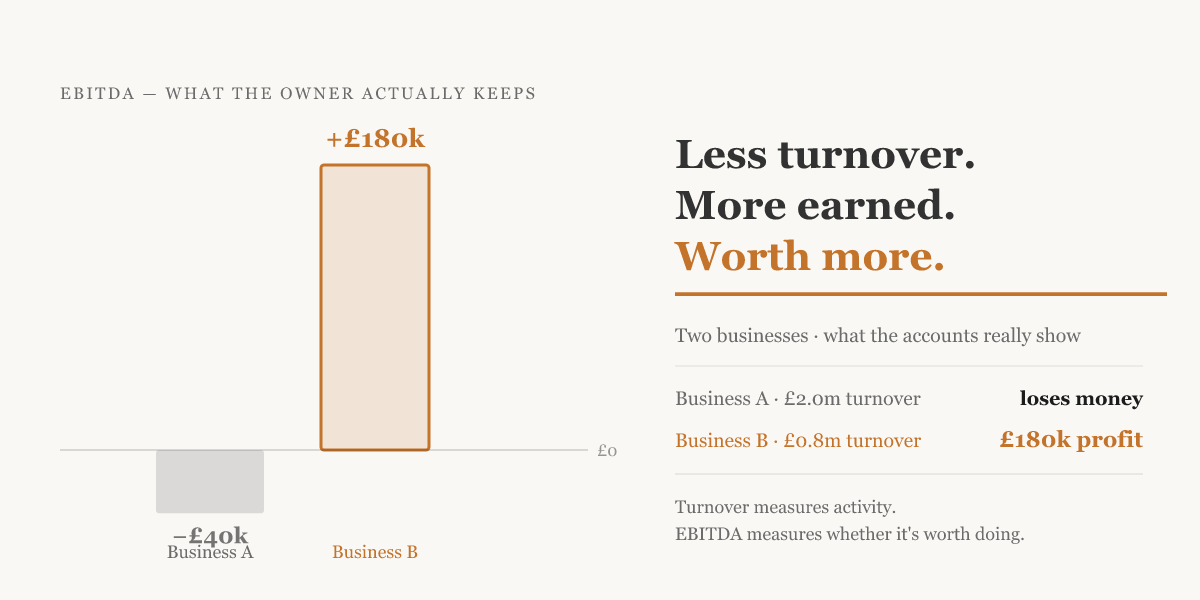
If you have ever put your business on the market, or thought about it, you probably led with turnover. It is the number everyone reaches for. It is also the number I pay the least attention to.
Here is what I look at instead, and why.
Turnover tells you how busy you are
Turnover is the total that came through the door before any costs. A business turning over two million pounds sounds bigger than one turning over eight hundred thousand. But I have seen the two million pound business losing money every month, and the eight hundred thousand pound one quietly paying its owner well and clearing its debts. Turnover measures activity. It does not measure whether that activity is worth doing.
EBITDA starts to tell you what it is worth
EBITDA stands for earnings before interest, tax, depreciation and amortisation. Stripped of the jargon, it is an attempt to show what the business actually earns from trading, before the effects of how it is financed and how its assets are written down on paper.
I use it because it lets me compare two businesses on the same footing. One might be loaded with debt, another might own its premises outright. One might have written down a lot of old equipment, another almost none. Those choices change the profit figure at the bottom of the accounts without changing how good the underlying trade is. EBITDA takes them out of the picture so I can see the trade itself.
Where EBITDA stops being useful
EBITDA is a starting point, not the answer. It ignores real costs that do not go away. Equipment wears out and has to be replaced. Interest has to be paid. Tax is due. A business with a strong EBITDA and a mountain of borrowing against it is not as healthy as the headline suggests. So I read EBITDA, then I put the interest and the capital spending back into the conversation, because that is what the next owner will actually live with.
What this means if you are thinking of selling
If you want a serious buyer to take you seriously, know your EBITDA and be able to explain it. Show me the adjustments you have made and why. A clean, honest set of figures, where the owner can walk me through what the business really earns, is worth more than a big turnover number with nothing behind it. I read accounts the way a bank manager does, because I used to be one. The owners who understand their own numbers are the ones I can move quickly with.
If any of this is live for you at the moment, and you would rather talk it through than guess, you can reach me directly at stephen@oceanusgroup.co.uk.
Ready to explore your options?
We're direct acquirers — no broker fees, total confidentiality, and no obligation to proceed.
Start a Confidential Conversation